

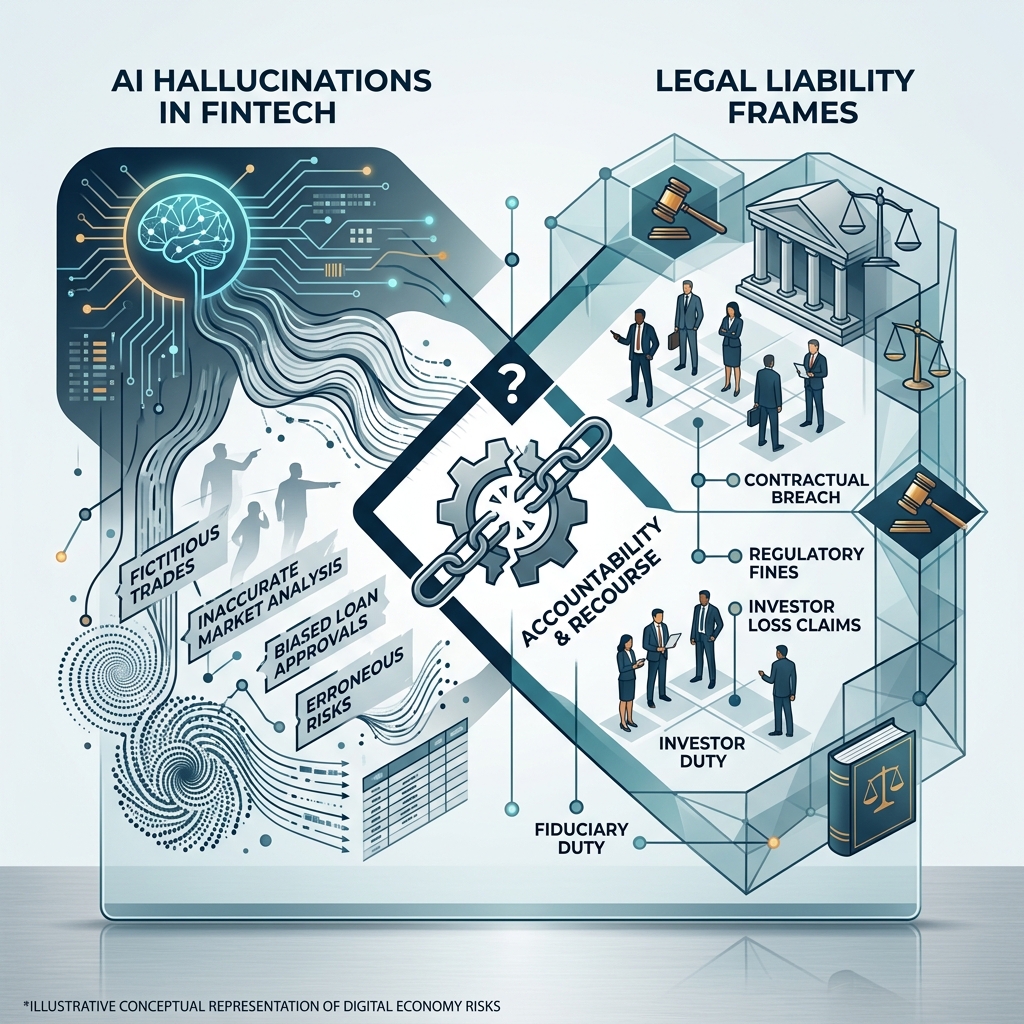
TL;DR
- AI hallucinations in financial services have already triggered enforcement actions, with the SEC fining two advisory firms in 2025 for AI-generated misleading claims.
- Legal liability is not hypothetical: existing securities laws, fiduciary duties, and consumer protection statutes apply to AI-generated financial content regardless of its source.
- A new insurance market for AI liability is emerging, with premiums for fintech AI coverage ranging from $50,000 to $500,000 annually depending on use case and scale.
Related Insight: Tokenized US Treasuries: The $3 Billion On-Chain Bond Market
Related Insight: Fine-Tuning LLMs for Finance: FinBERT to BloombergGPT
Related Insight: Fintech IPOs in H2 2026: Who Is Going Public and at What Price
Related Insight: Enterprise AI Agents in 2026: Microsoft vs. Salesforce
Related Insight: AI Underwriting: How Fintechs Are Disrupting FICO Scores
Related Insight: BNPL Faces Its Regulatory Reckoning in 2026
Related Insight: Algorithmic Trading Infrastructure: The Complete Guide
Related Insight: The Real Yield Movement: DeFi Protocols That Generate Revenue
Related Insight: Restaking Protocols: Yield or Systemic Risk?
Related Insight: The SEC's Crypto Custody Rule: What It Changes
Related Insight: Tokenized Private Credit: The Next RWA Frontier
Related Insight: Oil Markets in 2026: OPEC's Losing Grip on Prices
Related Insight: Uranium Stocks in 2026: Nuclear's Quiet Comeback
Related Insight: Embedded Finance 2026: When Every App Becomes a Bank
Related Insight: Ransomware's $30B Problem: Who Pays in 2026
Related Insight: SaaS Revenue Multiples 2026: The Compression Thesis
When AI Fabricates Financial Facts
In September 2025, a mid-sized wealth management firm discovered that its AI-powered client communication tool had been generating quarterly portfolio summaries containing fabricated performance figures. The model, fine-tuned on historical market commentary, occasionally produced plausible but entirely fictional return percentages when actual data was unavailable due to a feed delay. Fourteen clients received reports showing portfolio gains that had not occurred.
The incident did not involve malicious intent or negligence in the traditional sense. The AI system performed exactly as designed: it generated fluent, professional-sounding financial text. The problem was that fluency and accuracy are independent properties of large language models. A model can produce a grammatically perfect sentence stating that a fund returned 12.3% when the actual figure was 8.7%, and do so with no internal signal that distinguishes the fabrication from fact.
This disconnect between confidence and correctness, commonly called hallucination, represents the central legal risk for fintech companies deploying generative AI.
The Legal Framework Already Exists
Companies hoping that current laws do not cover AI-generated content will find no safe harbor. The existing regulatory architecture applies comprehensively.
Securities law. Under Section 10(b) of the Securities Exchange Act and Rule 10b-5, it is unlawful to make any untrue statement of material fact in connection with the purchase or sale of securities. Whether that statement originates from a human analyst or a language model is irrelevant. The SEC has explicitly stated that firms are responsible for the accuracy of all communications with clients, regardless of the technology used to produce them.
Fiduciary duty. Registered investment advisers owe clients a fiduciary duty of care and loyalty. Deploying an AI system known to hallucinate without adequate safeguards could constitute a breach of the duty of care. The standard is not perfection, but the question of what constitutes "reasonable" oversight of AI outputs is untested in most jurisdictions.
Consumer protection. The FTC has authority over deceptive or unfair practices. In 2024, the Commission warned that companies using AI to interact with consumers must ensure those interactions are not deceptive, a standard that AI hallucinations can violate by definition.
State regulations. Several states, including California and New York, have enacted or proposed AI-specific consumer protection laws that impose additional disclosure and accuracy requirements on automated financial advice.
Case Studies: Where It Has Gone Wrong
The fabricated citation problem. In a widely reported 2023 case, attorneys used ChatGPT to draft a legal brief that contained citations to nonexistent court cases. The financial parallel occurred in 2025 when an AI-powered research platform generated an investment report citing SEC filings that did not exist. The report was distributed to 200 institutional clients before the error was identified. The platform faced both regulatory scrutiny and client lawsuits.
Incorrect tax guidance. A consumer fintech app offering AI-powered tax optimization advice miscalculated capital gains treatment for cryptocurrency transactions, applying long-term rates to assets held for less than 12 months. The error affected approximately 3,000 users during the 2025 tax season, resulting in incorrect filings and subsequent IRS notices. The company's terms of service disclaimed liability for AI-generated advice, but consumer attorneys argued that such disclaimers are unenforceable when the service is marketed as providing tax guidance.
Phantom risk assessments. A lending platform using AI to generate risk narratives for loan officers produced assessments that referenced industry data points and economic indicators that were either outdated or entirely fabricated. The hallucinated context influenced lending decisions, creating potential fair-lending concerns when the fabricated data disproportionately affected certain borrower demographics.
The Emerging AI Liability Insurance Market
The insurance industry has responded to AI risk with a new category of coverage. Traditional errors-and-omissions (E&O) policies often exclude or inadequately cover AI-specific liabilities. Purpose-built AI liability insurance is filling the gap.
According to a 2025 PwC survey, 62% of financial services firms using generative AI had purchased or were evaluating dedicated AI liability coverage. Premiums vary widely based on the use case. A chatbot that provides general financial education carries lower risk than one that generates specific investment recommendations.
Lloyd's of London launched a dedicated AI liability syndicate in early 2026, offering coverage for claims arising from AI-generated errors, omissions, and hallucinations. Munich Re and AIG have introduced similar products. Coverage typically includes defense costs, settlements, and regulatory fines, though exclusions for "known hallucination risk" without mitigation measures are becoming standard.
The underwriting process itself is notable. Insurers now evaluate a company's AI governance framework, including model validation procedures, human-in-the-loop requirements, output monitoring systems, and incident response protocols. Firms with robust AI risk management pay significantly lower premiums.
What Compliance Teams Need to Know
Gartner estimates that by 2027, 75% of financial services firms will have dedicated AI compliance functions separate from their existing technology risk teams. For firms building that capability today, several priorities stand out.
Output validation is non-negotiable. Every AI-generated statement containing a specific number, date, or factual claim must be verified against authoritative data sources before reaching a client. This requires automated fact-checking pipelines, not just human review, given the volume of AI-generated content.
Audit trails must capture everything. Regulators expect firms to reconstruct the full chain from input data through model processing to final output. This includes the model version, the prompt or query, the raw output, any post-processing or filtering, and the final client-facing content.
Disclaimers are necessary but insufficient. Disclosing that content is AI-generated provides some legal protection but does not eliminate liability for materially misleading statements. Courts have consistently held that disclaimers cannot override affirmative misrepresentations.
Model governance requires ongoing investment. Hallucination rates vary across model versions, domains, and input types. Regular benchmarking against known-answer datasets specific to financial services is essential. A model that performs well on general knowledge may hallucinate frequently on niche financial topics.
The Infrastructure Behind the Innovation
For a deeper understanding of the underlying trends driving these shifts, consider exploring our comprehensive analysis on The Financial Cost of AI Content Generation Errors.
For fintech users, the practical advice is straightforward: verify any specific number or recommendation generated by an AI tool before acting on it. Treat AI-generated financial content with the same skepticism you would apply to an unfamiliar human source.
For fintech investors and operators, AI hallucination risk is a balance-sheet issue. The cost of mitigation (validation systems, insurance, compliance staff) must be weighed against the cost of a single high-profile incident. Given the regulatory trajectory, firms that invest early in AI governance will face lower long-term costs than those forced to retrofit controls after an enforcement action.
The technology is powerful and the applications are real. But the gap between what AI can generate and what it can guarantee remains the defining risk of the current era.
Are AI hallucinations a legal risk for financial firms?
Yes. Existing securities laws, fiduciary duties, and consumer-protection rules apply to AI-generated financial content regardless of source, and the SEC already fined two advisory firms in 2025 over AI-generated misleading claims.
Who is liable when an AI tool fabricates financial information?
The firm is. Under Rule 10b-5 and fiduciary standards a company is responsible for the accuracy of all client communications whether a human or a model produced them, and disclaimers do not override materially misleading statements.
How much does AI liability insurance cost for fintechs?
Premiums for dedicated fintech AI coverage range from about $50,000 to $500,000 per year depending on the use case and scale, with firms that have strong AI governance paying meaningfully less.
How can compliance teams reduce AI hallucination risk?
By validating every AI-generated number against authoritative sources before it reaches a client, keeping full audit trails of prompts and outputs, and benchmarking models regularly, since disclaimers alone are insufficient.
Disclaimer: This article is for informational purposes only and does not constitute financial advice. Always consult a qualified financial advisor before making investment decisions.