

TL;DR
- Spot Bitcoin ETFs collectively hold over $120 billion in AUM, making the Bitcoin ETF complex one of the most successful product launches in ETF history.
- BlackRock's IBIT dominates with roughly 50% market share, while fierce fee competition has driven expense ratios as low as 0.12%.
- ETFs have fundamentally changed Bitcoin's market structure: Price discovery is shifting from offshore crypto exchanges to regulated US markets, with ETF flows now serving as the primary demand signal.
Related Insight: Private Equity Secondaries: The $150B Market Institutions Now Love
Related Insight: Ethereum L2s in 2026: Which Chain Is Cheapest for DeFi?
Related Insight: Ethereum Blob Fees: The Hidden Revenue Stream
Related Insight: Hong Kong's Crypto Hub Ambition: Progress Report
The Fastest-Growing ETF Category in History
When the SEC approved 11 spot Bitcoin ETFs on January 10, 2024, it marked a watershed moment for cryptocurrency's integration into mainstream finance. Within 18 months, the combined AUM of these products surpassed $120 billion, a pace that outstripped every prior ETF category launch, including gold ETFs, which took five years to reach $100 billion in assets.
The speed of adoption reflects pent-up demand from financial advisors, family offices, and institutional allocators who required a regulated, exchange-traded vehicle to gain Bitcoin exposure. Prior to spot ETFs, institutional Bitcoin investment required navigating crypto exchanges, managing custody arrangements, or paying the steep premiums embedded in closed-end products like the Grayscale Bitcoin Trust (GBTC).
By mid-2026, the spot Bitcoin ETF market has consolidated around a handful of dominant players, with a long tail of smaller products struggling to attract meaningful assets.
AUM Rankings and Market Share
The competitive landscape among spot Bitcoin ETF issuers has produced clear winners and a compressed fee structure:
| ETF | Ticker | AUM (est.) | Expense Ratio | Custodian |
|---|---|---|---|---|
| iShares Bitcoin Trust | IBIT | ~$60B | 0.12% | Coinbase Custody |
| Fidelity Wise Origin | FBTC | ~$20B | 0.25% | Fidelity Digital Assets |
| ARK 21Shares Bitcoin | ARKB | ~$8B | 0.21% | Coinbase Custody |
| Bitwise Bitcoin | BITB | ~$5B | 0.20% | Coinbase Custody |
| Grayscale Bitcoin Trust | GBTC | ~$15B | 1.50% | Coinbase Custody |
| Grayscale Bitcoin Mini | BTC | ~$4B | 0.15% | Coinbase Custody |
BlackRock's IBIT has captured roughly half the market, leveraging the firm's distribution network across wirehouses, RIAs, and institutional platforms. Fidelity's FBTC benefits from the firm's self-custody model, where Fidelity Digital Assets serves as both the ETF's custodian and a regulated crypto platform. This vertical integration gives Fidelity unique operational control over the custody chain.
Grayscale's GBTC has experienced persistent outflows since converting from a closed-end trust to an ETF, shedding over $20 billion in assets as investors rotated into cheaper alternatives. Grayscale responded by launching the Bitcoin Mini Trust (BTC) at a competitive 0.15% expense ratio, successfully stemming some outflows, though the combined Grayscale products still trail BlackRock significantly.
The Fee War
The fee compression among Bitcoin ETFs has been remarkable. When IBIT launched at 0.25%, it was already among the cheapest Bitcoin investment vehicles. BlackRock subsequently cut the fee to 0.12% (after an initial promotional period at zero fees), forcing competitors to respond.
At 0.12% to 0.25%, Bitcoin ETF fees are now comparable to broad equity index ETFs, removing cost as a barrier for advisors recommending Bitcoin allocations. This is a stark contrast to GBTC's 1.50% management fee, which persists as a premium product for investors who have not yet migrated.
The fee war has implications for profitability. At 0.12% on $60 billion in assets, IBIT generates approximately $72 million in annual revenue for BlackRock, a modest contribution to the firm's $20 billion total revenue. The strategic value lies not in fee income but in client retention and platform stickiness: advisors who use iShares for Bitcoin exposure are more likely to use iShares for their entire portfolio.
Impact on Price Discovery
The introduction of spot ETFs has shifted Bitcoin's price discovery mechanism. Prior to ETFs, Bitcoin's price was set primarily on offshore exchanges like Binance, with the CME Bitcoin futures serving as the primary regulated venue. Since ETF launch, the correlation between ETF net flows and Bitcoin price movements has become the dominant market signal.
According to Bloomberg Intelligence, periods of sustained net ETF inflows above $500 million per week have preceded every significant Bitcoin price rally in 2024-2026. Conversely, weeks of net outflows have aligned with price corrections. This pattern suggests that ETF flows have become the marginal price-setting mechanism for Bitcoin.
The authorized participant (AP) creation and redemption process provides a direct link between ETF demand and Bitcoin spot markets. When new IBIT shares are created, BlackRock's APs (primarily Jane Street and JPMorgan) must purchase Bitcoin on spot markets or through OTC desks to deliver to the trust. This buying pressure transmits directly to the underlying market, unlike futures-based products where the link is indirect.
The shift toward US-regulated price discovery has also reduced Bitcoin's volatility during Asian trading hours, as the weight of US market participants now anchors price movements. Average daily volatility has declined from approximately 4% in 2022 to under 2.5% in 2026, a structural change that ETF analysts attribute partly to the institutional stabilization effect.
Custodial Concentration Risk
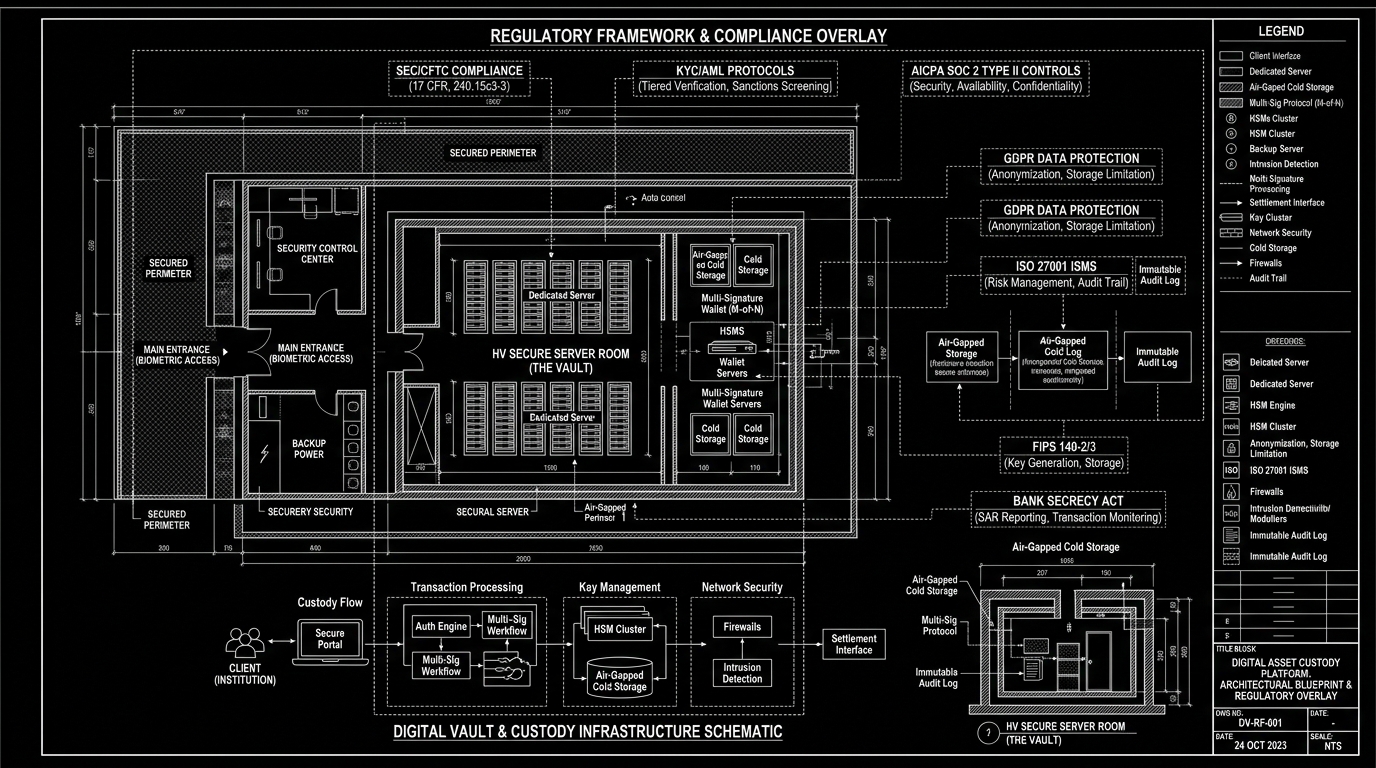
One under-discussed risk in the Bitcoin ETF ecosystem is custodial concentration. Coinbase Custody serves as the custodian for IBIT, ARKB, BITB, GBTC, and most other spot Bitcoin ETFs, holding an estimated 1 million BTC or more on behalf of ETF issuers. This concentration creates a single point of failure that the market has not fully priced.
If Coinbase experienced a significant security breach, regulatory action, or operational failure, the impact would cascade across nearly all spot Bitcoin ETFs simultaneously. The SEC has acknowledged this risk in comment letters but has not mandated custodial diversification.
Fidelity's self-custody model through Fidelity Digital Assets provides the only significant alternative. Some market participants argue that the SEC should require ETF issuers to diversify custodians or establish minimum custodial insurance requirements, similar to FDIC protections for bank deposits.
Broader Market Structure Effects
Bitcoin ETFs have created ripple effects across the crypto market structure. Trading volume on US-regulated venues (NYSE, Nasdaq, CBOE) now rivals or exceeds volume on dedicated crypto exchanges for Bitcoin price discovery. This has increased the relevance of traditional market hours, with Bitcoin trading activity increasingly concentrated during US equity market sessions.
The success of Bitcoin ETFs has also accelerated applications for other crypto ETFs. Spot Ethereum ETFs were approved in May 2024 and have accumulated approximately $15 billion in AUM. Applications for Solana, XRP, and Litecoin ETFs are pending before the SEC, with Solana considered the most likely next approval.
For the broader ETF industry, Bitcoin products have attracted a younger demographic of investors who may not have otherwise opened brokerage accounts. Schwab, Fidelity, and Robinhood have all reported increases in new account openings correlated with Bitcoin ETF launch periods.
The Infrastructure Behind the Innovation
For a deeper understanding of the underlying trends driving these shifts, consider exploring our comprehensive analysis on How Machine Learning Predicts Stock Market Crashes.
Spot Bitcoin ETFs have largely succeeded in their promise: making Bitcoin accessible through existing brokerage infrastructure at low cost. For investors who want Bitcoin exposure without managing wallets or exchanges, ETFs are now the obvious choice.
However, ETF investors should understand what they are giving up. They do not hold Bitcoin directly; they hold shares in a trust that holds Bitcoin. They cannot transfer their Bitcoin to a personal wallet, use it in DeFi protocols, or lend it for yield. They are exposed to custodial concentration risk at Coinbase and to the operational risks of the ETF structure itself.
The key metrics to monitor are weekly net flow data (available from CoinGlass and Bloomberg), the GBTC outflow trend (which appears to be stabilizing), and regulatory developments around new crypto ETF approvals. A spot Solana ETF approval would likely trigger another wave of institutional capital into the crypto ecosystem, benefiting the broader market beyond Bitcoin.
How big are spot Bitcoin ETFs?
Spot Bitcoin ETFs collectively hold over $120 billion in assets as of mid-2026, reaching $100B+ far faster than gold ETFs did, with BlackRock's IBIT holding roughly half the market at about $60 billion.
Which Bitcoin ETF has the lowest fees?
Fee competition has pushed expense ratios as low as 0.12% (IBIT), comparable to broad equity index funds, while Grayscale's legacy GBTC still charges 1.50%.
How have ETFs changed Bitcoin's market?
They shifted price discovery from offshore exchanges to US-regulated markets, made ETF net flows the dominant demand signal, and coincided with average daily volatility falling from about 4% in 2022 to under 2.5% in 2026.
What are the risks of holding a Bitcoin ETF instead of Bitcoin?
You own shares in a trust, not Bitcoin you can move to a wallet, use in DeFi, or lend, and you face custodial concentration risk since Coinbase Custody holds Bitcoin for most major ETFs.
Disclaimer: This article is for informational purposes only and does not constitute financial advice. Always consult a qualified financial advisor before making investment decisions.