
TL;DR
- The global edge computing market is valued at $61 billion in 2026, projected to reach $130 billion by 2030, growing at a 21% compound annual rate.
- Manufacturing, retail, and financial services are the top three enterprise adopters, driven by the need for low-latency data processing that centralized cloud architectures cannot deliver.
- Edge computing complements rather than replaces cloud: The hybrid model where edge handles real-time processing while cloud manages storage and analytics is becoming the enterprise standard.
What Edge Computing Solves
Edge computing processes data closer to where it is generated, reducing the latency, bandwidth costs, and privacy risks associated with sending everything to centralized cloud data centers. The concept is simple. The engineering required to deliver it at enterprise scale is not.
A manufacturing sensor generating vibration data 1,000 times per second cannot wait 50-100 milliseconds for a round trip to an AWS region in Virginia. An autonomous vehicle processing LiDAR data cannot tolerate cloud latency when making split-second steering decisions. A retail store running real-time inventory management needs local processing to function when internet connectivity is intermittent.
These use cases, and thousands like them, are driving enterprise adoption of edge computing infrastructure. Grand View Research values the global edge computing market at $61 billion in 2026, with projections reaching $130 billion by 2030. Gartner estimates that by 2028, 75% of enterprise-generated data will be created and processed outside a traditional centralized data center or cloud, up from approximately 10% in 2020.
Enterprise Use Cases Driving Adoption
Manufacturing and Industrial IoT
The manufacturing sector accounts for approximately 25% of edge computing spending, making it the largest vertical market. Predictive maintenance, quality inspection, and process optimization require real-time data analysis at the factory floor level.
Siemens' Industrial Edge platform connects over 100,000 machines across customer factories, processing sensor data locally and sending only aggregated insights to the cloud. BMW deploys edge computing at 30 manufacturing plants for robotic assembly line coordination, reducing defect rates by 12% compared to cloud-dependent architectures, according to company presentations.
The economics are compelling. McKinsey estimates that predictive maintenance powered by edge computing reduces unplanned manufacturing downtime by 30-50%, translating to annual savings of $200,000 to $1 million per factory. For a company operating dozens of plants, the cumulative savings easily justify seven-figure edge infrastructure investments.
Retail and Customer Experience
Retailers use edge computing for real-time inventory tracking, cashierless checkout systems, and personalized in-store promotions. Amazon's Just Walk Out technology, deployed in Amazon Fresh and third-party stores, relies on edge computing to process camera and sensor feeds locally, determining what shoppers select from shelves without sending video to the cloud.
Walmart has deployed edge computing nodes in over 4,700 U.S. stores, processing data from shelf cameras, HVAC systems, and refrigeration units locally. The edge infrastructure supports Walmart's inventory accuracy initiatives, which the company credits with reducing out-of-stock incidents by 30% since implementation.
Financial Services
Low-latency requirements in financial services make edge computing a natural fit. High-frequency trading firms have operated edge-like infrastructure for decades, colocating servers in exchange data centers to minimize execution latency. The broader financial sector is now adopting edge computing for fraud detection, ATM management, and branch office operations.
JPMorgan Chase processes transaction fraud detection at edge locations to achieve sub-millisecond response times, flagging suspicious transactions before they complete rather than after. The bank's edge infrastructure spans data centers near major financial exchanges and regional processing hubs.
Healthcare
Hospital edge computing enables real-time patient monitoring, medical imaging analysis, and surgical robotics. Processing sensitive patient data locally also addresses HIPAA compliance concerns by minimizing data movement. GE HealthCare's Edison platform runs AI diagnostic models at the hospital edge, analyzing imaging data without sending it to external cloud environments.
Edge vs. Cloud: Complement, Not Competitor
A common misconception positions edge computing as a replacement for cloud computing. The reality is more nuanced. Edge and cloud serve different roles in a unified architecture.
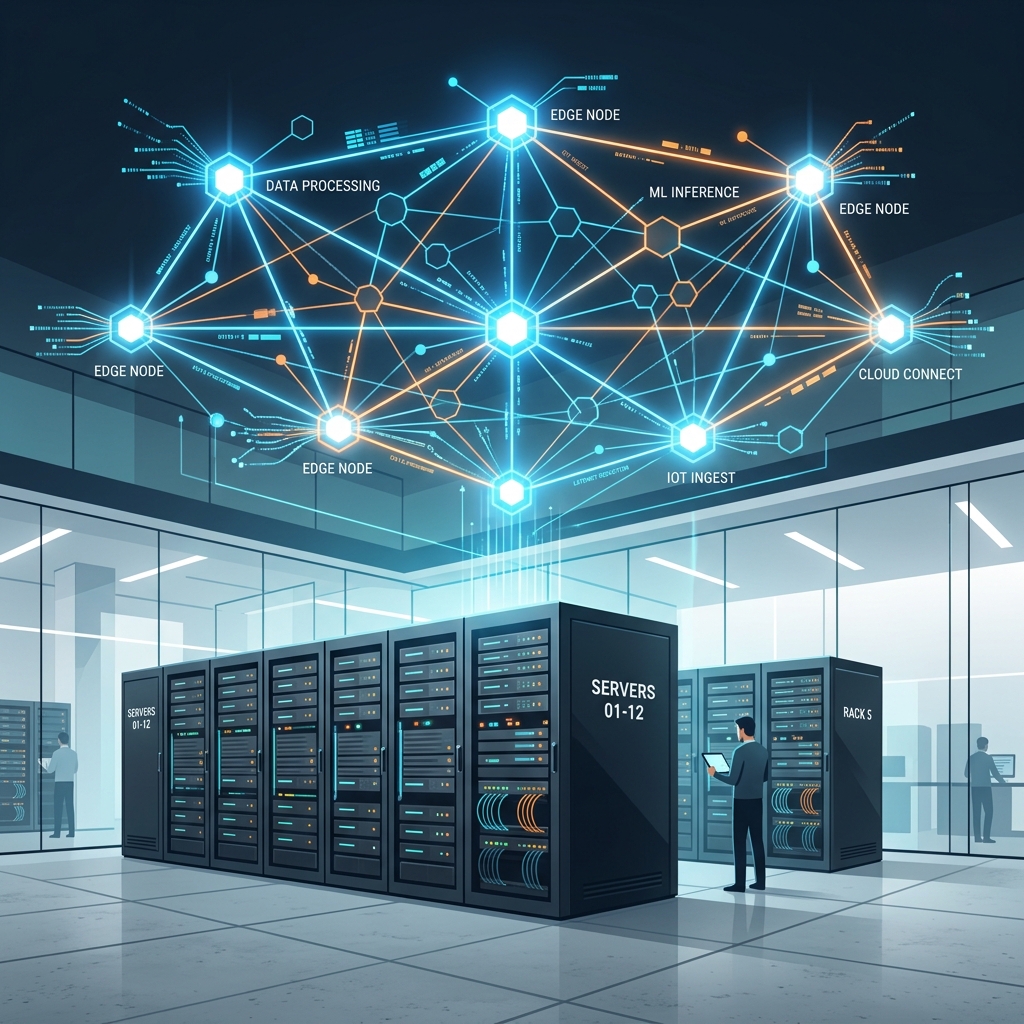
Edge handles real-time processing, low-latency decision-making, and data filtering. Cloud provides centralized storage, large-scale analytics, model training, and cross-location aggregation. The relationship is symbiotic: edge nodes reduce the volume of data transmitted to the cloud (lowering bandwidth costs), while cloud platforms manage, update, and orchestrate the software running on edge devices.
AWS (Outposts, Wavelength, Local Zones), Azure (Azure Stack Edge, Azure IoT Edge), and Google Cloud (Distributed Cloud Edge) all offer edge products that extend their cloud platforms to customer locations. This hybrid approach allows enterprises to use familiar cloud tools and APIs for edge workloads, reducing the learning curve and operational complexity.
The convergence of edge and cloud creates a computing continuum that Gartner describes as "distributed cloud," a model where cloud services run in multiple locations (central, regional, and edge) but are managed as a single architecture.
Key Players in the Edge Ecosystem
The edge computing market spans hardware, software, and services, with different companies competing at each layer.
Infrastructure and CDN providers. Cloudflare (NET) operates one of the largest edge networks with over 310 points of presence in 120+ countries. The company's Workers platform allows developers to run application code at the edge, reducing latency for web applications and APIs. Cloudflare's revenue reached $2.1 billion in trailing twelve months, growing 28% year-over-year.
Fastly (FSLY) and Akamai Technologies (AKAM) compete in edge content delivery and security. Akamai has pivoted aggressively toward edge compute and cloud services, generating $4 billion in annual revenue with its combined CDN, security, and compute platform.
Hardware and platform vendors. Dell Technologies and HPE sell edge servers and ruggedized computing hardware designed for factory floors, retail stores, and telecommunications towers. Dell's edge portfolio generated approximately $3 billion in revenue in fiscal 2026. NVIDIA's Jetson platform powers AI inference at the edge for robotics, drones, and autonomous machines.
Telecommunications companies. Mobile operators including AT&T, Verizon, and Deutsche Telekom offer multi-access edge computing (MEC) services that colocate enterprise computing workloads in cell tower sites and central offices. The rollout of 5G networks amplifies the value of telco-hosted edge computing by providing high-bandwidth, low-latency wireless connectivity to edge applications.
Specialized edge platforms. Companies like Zededa, Avassa, and Sunlight provide orchestration software for managing thousands of distributed edge devices, solving the operational challenge of deploying, monitoring, and updating edge infrastructure at scale.
Market Growth Drivers
Several structural trends support sustained edge computing adoption.
Data volume explosion. IDC forecasts that the global datasphere will reach 291 zettabytes by 2027, with the majority generated by IoT sensors, cameras, and connected devices at the edge. Transmitting all this data to centralized clouds is neither technically feasible nor economically rational.
5G deployment. 5G networks provide the wireless connectivity layer that many edge applications require. Ultra-reliable low-latency communication (URLLC) and network slicing capabilities make 5G the transport mechanism for industrial IoT and connected vehicle applications.
AI inference at the edge. Running AI models locally (inferring predictions from trained models) avoids the latency and privacy concerns of cloud-based inference. The edge AI inference market is growing at 30%+ annually, according to ABI Research.
Regulatory requirements. Data sovereignty and privacy regulations (GDPR, PIPL, DPDP Act) encourage local data processing to minimize cross-border data transfers, a requirement that edge computing naturally satisfies.
Scaling Solutions for the Next Decade
As the sector continues to evolve, maintaining a holistic view of the ecosystem is critical. You can find more actionable insights in our recent report: OpenAI vs Anthropic vs Google: The Enterprise AI Race.
Edge computing is a durable, multi-year growth theme with exposure available across several investment vectors.
Cloudflare (NET) offers the broadest pure-play edge platform, combining content delivery, security, and developer-focused compute services. The stock trades at approximately 20x forward revenue, a premium justified by 28%+ growth and expanding margins.
Akamai (AKAM) provides a value alternative with lower growth but strong profitability and a diverse customer base.
NVIDIA (NVDA) benefits from edge AI inference through its Jetson and L4 GPU platforms, though edge represents a small fraction of the company's total revenue.
Dell Technologies (DELL) and HPE (HPE) offer edge hardware exposure within diversified IT portfolios, providing more conservative risk profiles.
The convergence of edge computing, AI, 5G, and IoT creates a compound growth effect that makes the sector difficult for enterprise IT budgets to ignore. For investors, the key is identifying companies that capture recurring revenue from edge deployments rather than one-time hardware sales.
How big is the edge computing market?
The global edge computing market is valued at about $61 billion in 2026 and is projected to reach $130 billion by 2030, a roughly 21% annual growth rate, according to Grand View Research.
What is edge computing used for?
It processes data close to where it is generated for low latency, with manufacturing, retail, and financial services the top adopters for uses like predictive maintenance, cashierless checkout, and sub-millisecond fraud detection.
Does edge computing replace the cloud?
No. Edge and cloud are complementary: edge handles real-time processing and data filtering while the cloud handles storage, analytics, and model training, a hybrid 'distributed cloud' model that is becoming the enterprise standard.
How can investors get exposure to edge computing?
Options span pure-play platforms like Cloudflare, value plays like Akamai, AI-inference exposure through NVIDIA, and edge hardware via Dell and HPE, with recurring-revenue models preferable to one-time hardware sales.
Disclaimer: This article is for informational purposes only and does not constitute financial advice. Always consult a qualified financial advisor before making investment decisions.